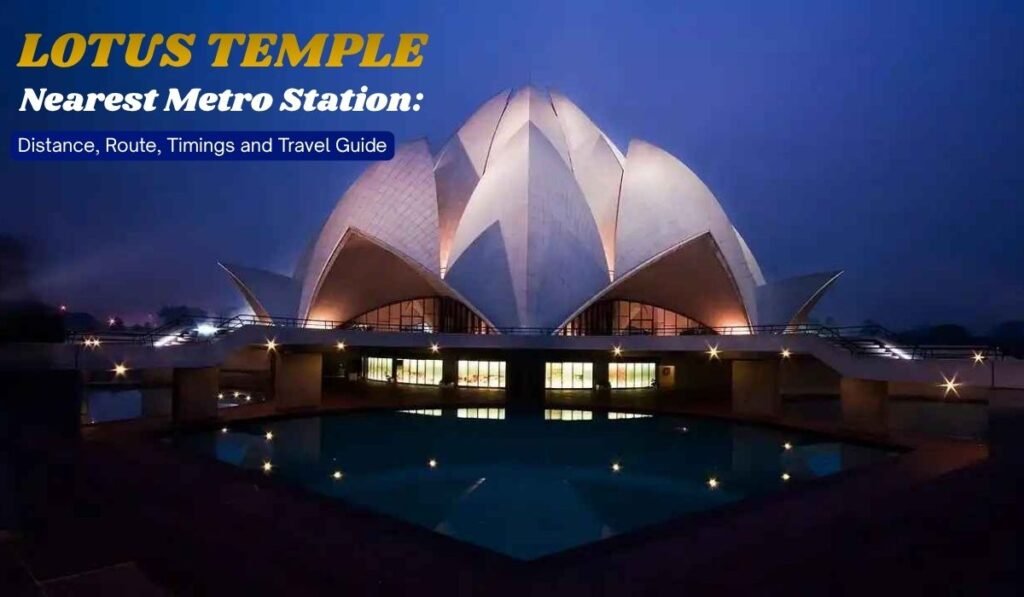
If you are visiting the Lotus Temple in Delhi, travelling by metro is one of your easiest and most convenient options. Nearest metro to Lotus TempleKalkaji Mandir Metro Station, which is an inter nodal station on the Violet Line and Magenta Line of Delhi metro. The station is approximately 400-500 m away from the temple, so it can be reachable on foot to the entrance.
The Lotus Temple is in Bahapur, Kalkaji, South Delhi. The Bahá’í House of Worship is renowned for its unique white marble lotus shaped building where visitors from different religions and cultures are warmly welcomed. The temple has good metro links, which means you can reach it conveniently from various points in Delhi and the National Capital Region.
Read on to know about the nearest metro station, distance between lotus temple and nearby stations along with timings, entry fees and key tips.
Lotus Temple Nearest Metro Station
Kalkaji Mandir Metro Station is supposed to be the nearest metro station of Lotus Temple and also serve as the most convenient one. It is beneficial for the visitors travelling from other parts of Delhi, the Siri Fort can be approached by Violet Line and Magenta Line.
Kalkaji Mandir Metro Station and Lotus Temple are 400–500 metres from each other according to the route of travel and the distance between both is taken into consideration. The first class as well as the economy travelers take 5–10 minutes walking distance, From the station to the entrance of this temple.
Lotus Temple Nearest Metro on Which Line?
Kalkaji Mandir Metro Station is got two Delhi Metro corridors-
Violet line: The Violet Line runs between Kashmere Gate to Raja Nahar Singh (Ballabhgarh), which allows easier access from many parts of central, south and south-eastern Delhi.
Magenta Line: The magenta line connects major areas such as Janakpuri West, Hauz Khas, and Kalkaji Mandir to the Botanical Garden. Kalkaji Mandir is then especially well connected to travellers from the Noida side or west Delhi.
Since the two lines have a common terminal at Kalkaji Mandir, it allows passengers greater flexibility in trip planning.
Lotus Temple Nearest Metro Station Distance
It is around 0.4 km to 0.5 km from Kalkaji Mandir Metro Station, this distance is what most reviews ardently mention One source claims about 435 metres, while another source states nearly 500 metres. The source of the discrepancy is the specific trace point used to measure a journey.
In terms of the distance for practical travel planning, this is about 500m.
Distance from Nearby Metro Stations
| Metro Station | Metro Line | Approx. Distance from Lotus Temple | Approx. Walking Time |
| Kalkaji Mandir | Violet & Magenta | 0.4–0.5 km | 5–10 minutes |
| Okhla NSIC | Magenta | Around 0.6 km | 7–10 minutes |
| Nehru Place | Violet | Around 0.7 km | 9–12 minutes |
| Nehru Enclave | Magenta | Around 1.1 km | 13–15 minutes |
| Govind Puri | Violet | Around 1.1 km | 13–15 minutes |
Distances and walking times are approximate and can vary depending on the route and entrance used.
How to Reach Lotus Temple by Different Transport Options
About Lotus Temple LOTUS TEMPLE; Bahapur, Kalkaji, South Delhi with good metro and road and public transport connectivity. The simplest is the Delhi Metro — one nearest to each of the temples, for the majority of visitors. As per the Bahá’í House of Worship official website, it is a 5-minute walk from Kalkaji Mandir Metro Station and Okhla NSIC Metro Station towards the temple.
1. By Metro:
One of the easiest and cheapest ways to reach Lotus Temple is by catching a metro.
The nearest metro station to the Lotus Temple is Kalkaji Mandir and can be reached through both the Violet Line and Magenta Line. Once you disembark the train, it is a ~5 minute walk to the temple.
Closest is Okhla NSIC Metro Station on the Magenta Line, as well about 5 minutes from the temple.
Its connectivity with interchange makes it one of the most convenient temple if you are travelling from different parts of Delhi.
2. From New Delhi Railway Station:
If you are arriving at New Delhi Railway Station, the metro is a budget-friendly option.
Take the Yellow Line from New Delhi Metro Station towards the south side and change to the Violet Line at Central Secretariat. Continue towards Kalkaji Mandir and get down at Kalkaji Mandir Metro Station. From there, walk approximately 500 metres to Lotus Temple.
The official Lotus Temple website states that the temple is around 15.4 km from New Delhi Railway Station, while a taxi or auto-rickshaw journey may take approximately 40 minutes, depending on traffic.
3. From Delhi Airport:
When a traveller reaches Delhi Airport, they can take the metro, taxi or vehicle.
For those traveling via metro from Terminal 1, directions by Lotus Temple recommend that visitors ride the Magenta Line towards Botanical Garden and alight at Okhla NSIC Metro Station. Lotus Temple is around 650 metres from there.
Another comfortable method for travel is to take an airport transfer via taxi or prepaid cab. According to the official website, it is nearly 16.6 km from IGI Airport (or approximately 45 minutes by car; could vary according to traffic conditions) to the temple
4. By Auto-Rickshaw:
In South Delhi, auto-rickshaws are the most easily available alternative and can play a big role in traveling at his last mile. If you drop by Kalkaji Mandir or Okhla NSIC Metro Station and are not willing to walk, an auto up to Lotus Temple is suggested.
An auto can definitely be easier than walking particularly for visitors with luggage, elderly peopleMay or during sweltering hot weather.
5. By Taxi or Cab:
A cab or taxi is the best option if you are travelling with your family or going straight from your hotel, railway station / airport.
Feed the incense to your destination – “Bahá’í House of Worship – Lotus Temple, Bahapur, Kalkaji” It is Bahapur, Kalkaji, New Delhi – 110019.
The best part about the cab is that it leaves you near the entrance of the temple without having to switch a metro or walk too much. Although Delhi’s traffic situation is a different kettle of fish altogether and can go in several directions at peak hours.
6. By Bus:
Delhi buses are also available for travel in Kalkaji, Nehru Place, Govindpuri and Okhla area. If taking the bus, take one that will drop you near Kalkaji or Lotus Temple Road and walk or auto from there to the entrance.
The routes of buses and services may vary; it is a good practice to check the updated route on a live navigation app or the Delhi public transport app before you set out for your journey!
7. By Private Car:
You can go to Lotus temple by your own private car via Kalkaji road and Bahapur road. According to the official website, a DDA parking space is available opposite the main gate, therefore private vehicles can serve as a practical transport choice for anyone planning on a visit.
Nonetheless, parking can sometimes be scarce on weekends and other busier times. Getting there early is good for parking.
Lotus Temple Opening Time and Entry Fee
Lotus Temple generally opens its door from Tuesday to Sunday and closes on Mondays. Winter timings of 9 AM – 5:30 PM are a commonly published visitor schedule; summer the schedule could be extended to 7 PM. Entry is free.
Considering that visitor timings can be impacted from periodic calendar or extraordinary courses of action, it is prudent to affirm the timing before you set off on your excursion.
| Visitor Information | Details |
| Opening Days | Tuesday to Sunday |
| Closed | Monday |
| Summer Timing | Around 9:00 AM–7:00 PM |
| Winter Timing | Around 9:00 AM–5:30 PM |
| Entry Fee | Free |
Also Read: Delhi Sarai Rohilla Nearest Metro Station / Qutub Minar Nearest Metro Station / Janpath Market Nearest Metro
Key Features of Lotus Temple
- Lotus-Shaped Architecture: Designed in the form of a blooming lotus, the temple represents peace, purity and beauty.
- 27 Marble Petals: The iconic structure features 27 marble-clad petals arranged in groups.
- Nine Entrances: The temple has nine entrances, reflecting its welcoming and inclusive nature.
- Nine Surrounding Pools: Nine pools surround the temple and add to its beauty while supporting natural cooling.
- Spacious Prayer Hall: The prayer hall can accommodate around 1,300 people and has no idols, statues or altars.
- White Greek Marble: The temple is covered with high-quality white marble sourced from Greece.
- Beautiful Landscaped Gardens: Well-maintained gardens and lawns surround the temple, creating a peaceful atmosphere.
- Natural Lighting and Ventilation: The unique petal design allows natural light and air to enter the building.
- Open to Everyone: People from all religions, cultures and backgrounds can visit the temple for prayer, meditation and quiet reflection.
- Eco-Friendly Features: The complex uses initiatives such as rainwater harvesting, wastewater treatment and solar power to support sustainable operations.
Approximate Property Prices in Kalkaji
| Property Type | Approximate Price Range |
| 1 BHK | ₹14 lakh – ₹1.93 crore |
| 2 BHK | ₹27.5 lakh – ₹2.50 crore |
| 3 BHK | ₹49.75 lakh – ₹4.02 crore |
| 4 BHK | ₹36.3 lakh – ₹10 crore |
| Builder Floors | From around ₹7,000/sq. ft. |
| Premium/Luxury Properties | ₹3 crore onwards |
Why Is Lotus Temple Famous?
Lotus Temple is one of Delhi’s most famous landmarks because of its unique architecture, peaceful atmosphere and inclusive spiritual message. It attracts both Indian and international visitors throughout the year.
- Unique Lotus-Shaped Design: The temple is designed like a blooming lotus flower, making it one of Delhi’s most recognisable buildings.
- Stunning White Marble Architecture: Its 27 marble-clad petals create an elegant structure that looks especially impressive from the surrounding gardens and pools.
- Open to Everyone: The Bahá’í House of Worship welcomes people of all religions and backgrounds for prayer, meditation and quiet reflection.
- Peaceful Environment: Unlike many tourist attractions, Lotus Temple offers a calm atmosphere where visitors can spend time in silence and meditation.
- Award-Winning Architecture: Designed by Iranian architect Fariborz Sahba, the temple has received several architectural awards and international recognition.
- Beautiful Gardens and Pools: Nine pools and landscaped gardens surround the temple, adding to its visual appeal and peaceful surroundings.
- No Religious Idols or Rituals: The prayer hall does not contain idols, statues or altars, reflecting the Bahá’í principle of the oneness of humanity and religions.
- Popular Tourist Attraction: Its distinctive design and central location in South Delhi make it a must-visit destination for tourists exploring Delhi.
History of Lotus Temple
| Aspect | Details |
| Planning & Design | The Lotus Temple was designed by Iranian architect Fariborz Sahba. |
| Construction | Construction began in 1980 and was completed in 1986. |
| Funding | The project was funded through voluntary contributions from Bahá’ís worldwide. |
| Opening | The temple was officially opened to the public on 24 December 1986. |
| Architecture | Its design is inspired by a blooming lotus, featuring 27 marble-clad petals and nine surrounding pools. |
| Significance | It represents peace, unity, equality and the oneness of humanity and welcomes people from all religions. |
| Purpose | It serves as a Bahá’í House of Worship where visitors can pray, meditate and reflect in silence. |
| Recognition | The temple has received several architectural awards and international recognition for its unique design. |
| Tourism | Since its opening, it has become one of Delhi’s most popular tourist attractions. |
Other Metro Stations Near Lotus Temple
While Kalkaji Mandir is the most lucrative option, there are also other stations in and around it which will work well.
- Okhla NSIC Metro Station: As per the station listing available currently, it’s about 600 meters away from Lotus Temple. This station can be handy if your route naturally takes you near the Magenta Line.
- Nehru Place Metro Station: ON VIOLET LINE, It is also near Lotus Temple. It’s about a 700m distance (but the pedestrian walk route is actually longer).
With zero points of development for an average visitor however, Kalkaji Mandir makes for a simpler choice due to its adjacency and interchange connectivity.
Lotus Temple Metro Route from Popular Areas
From New Delhi Railway Station
In case you are beginning your journey from New Delhi Railway Station, you could take the Yellow Line and switch to an appropriate connecting line for Kalkaji Mandir. A common route, which people prefer is to travel on the Yellow Line and switch at a convenient interchange to further head towards Kalkaji Mandir.
Given that Delhi Metro routes can change quickly with service patterns, it is best to consult the live route (better through approved journey planner or app) for Delhi metro before travel.
From Noida
Noida travellers can often avail the Magenta Line and head towards Kalkaji Mandir. Kalkaji Mandir directly gets out from the Magenta Line via this and that may be an easy one for many Noida passengers.
From South Delhi
If you’re heading to these locations from areas like Saket, Malviya Nagar or Hauz Khas, you could take the Magenta Line or an interchange using (depending on your precise starting station) the Violet Line.
From Central Delhi
Central Delhi travellers in turn can take the Violet Line after changing at the intermodal station. Final Metro Leg – Destination Station: Kalkaji Mandir
Best Time to Visit Lotus Temple
When is the best time to visit? The mornings are typically warm too, as the weather remains and feels slightly different with the environment.
Late afternoon might also be an excellent selection, especially since then you will get to see the temple exterior and surroundings in softer daylight. On weekends and holidays, however, there is often more going on.
If travelling by metro, an earlier visit will also help you to avoid the peak commuting times.
Lotus Temple Nearest Metro: Quick Summary
Kalkaji Mandir Metro Station is the nearest metro station to Lotus Temple with access via the Violet and Magenta Lines. Located about 400-500 m away from the Lotus Temple, it is typically a good 5-10 min walk.
And, Okhla NSIC is not the only one close by; Nehru Place too serves as an alternative. But, Kalkaji Mandir is ideally the easiest as it merges short walking distance with best metro connectivity.
Delhi being one of the most famous cities in India, a visit to this architectural site is just a metro ride away for an affordable Delhi trip.
Also More: Delhi Cantt Nearest Metro Station / Shakti Nagar Nearest Metro Station / Jantar Mantar Delhi Nearest Metro Station
FAQs About Lotus Temple Nearest Metro Station
1. Which is the Lotus Temple nearest metro station?
Kalkaji Mandir Metro Station is the nearest and most convenient metro station for Lotus Temple. It is served by both the Violet Line and Magenta Line and is within a short walking distance of the temple.
2. What is the distance from Kalkaji Metro to Lotus Temple?
The distance from Kalkaji Mandir Metro Station to Lotus Temple is approximately 400–500 metres. It generally takes around 5–10 minutes to walk, depending on the exit and walking route.
3. What is the Lotus Temple opening time?
Lotus Temple is generally open from Tuesday to Sunday and remains closed on Mondays. The current visitor schedule should be checked before travelling because timings can vary by season or special arrangements.
4. What is the ticket price for Lotus Temple?
Entry to Lotus Temple is free. Visitors do not need to purchase an entry ticket to enter the temple complex. However, metro fares for reaching Kalkaji Mandir are separate and depend on the starting station.
5. Is Lotus Temple on the Yellow Line?
No, Lotus Temple does not have a Yellow Line station directly next to it. The nearest convenient station is Kalkaji Mandir, which is served by the Violet Line and Magenta Line. Passengers travelling on the Yellow Line need to change to a connecting metro line to reach Kalkaji Mandir.
Read More: India Gate Nearest Metro Station / Palika Bazar Nearest Metro Station / Agrasen Ki Baoli Nearest Metro Station